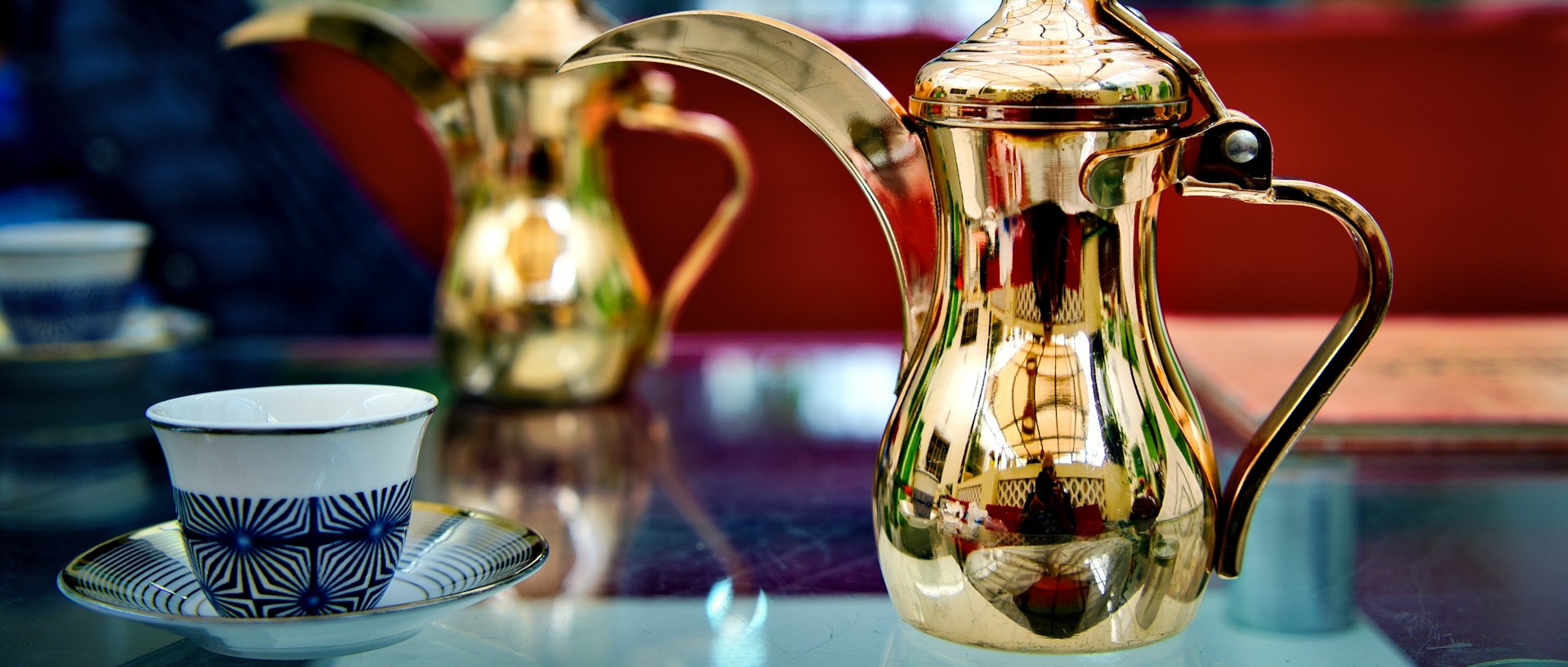
Gahwa is among the oldest documented coffee preparations in the world, tracing directly to the earliest coffee culture of the Arabian Peninsula before the roasting technique that defines modern coffee was fully established. Its pale colour and spice-forward character are not marks of inferior preparation — they are the original preparation.
Origin and history
Coffee's earliest cultivation was in Ethiopia, but its development as a beverage culture occurred on the Arabian Peninsula — in Yemen and the Hejaz (western Saudi Arabia) — from the 14th to 16th centuries. Qahwa was the original Arabic word for coffee (later evolving into the European café, coffee, Kaffee). The drink served at early Yemeni and Arabian coffeehouses was spiced and lightly roasted — a direct ancestor of modern gahwa.
The darker-roasted espresso style that dominates global coffee culture today developed separately, first in Turkey and then in European café culture. The Arabian Peninsula retained the original lighter-roast tradition, which became codified as the culturally significant hospitality beverage it is today.
Saudi Arabia, along with the UAE, Bahrain, Kuwait, Oman, and Qatar, inscribed Al-Qahwa on the UNESCO Intangible Cultural Heritage list in 2015, reflecting its centrality to Gulf cultural identity.
Technical structure
- Beans: Green or very lightly roasted arabica, ground medium-coarse. The colour after roasting should be pale yellow to golden — not brown.
- Cardamom: Ground cardamom is the primary flavouring, added liberally — approximately 1 teaspoon per 200 ml of water.
- Optional additions: A few saffron threads, 2–3 cloves, a small piece of dried ginger, a few drops of rosewater.
- Process: Water boiled in the dallah, coffee added, simmered for 10–15 minutes. Filtered through a natural fibre strainer before serving.
- Serving vessel: Small handleless porcelain cups (finjan or gahwa cup), filled no more than one-third full.
The hospitality ritual
Gahwa is poured with the right hand, using the dallah. The muqahwi (coffee server) moves from guest to guest and pours a small amount — perhaps 20–30 ml. The guest shakes the cup gently when they wish no more. The first cup is always accepted; subsequent cups are optional. Dates (tamr) are served alongside as the traditional pairing.
Gahwa and the major spiced coffee traditions
Gahwa shares the spiced, lightly roasted tradition with several other preparations:
- Ethiopian Jebena Bunna: Roasted darker, unspiced, served in a ceremony.
- Café de Olla: Spiced with cinnamon, sweetened with piloncillo — a Mexican parallel.
- Moroccan kahwa: Shares cardamom and spice additions.
Best served as
Very small quantities, at any time of day, accompanied by dates. Not sweetened — the sweetness comes from the dates. Consumed slowly and repeatedly as a gesture of hospitality extended and received. The correct response to a refill is a small side-to-side shake of the cup, signalling satisfaction.
How to prepare
- Lightly roast green beans in a flat pan over medium heat until pale golden — not brown. Stir constantly. This takes 8–12 minutes. Alternatively, use pre-roasted gahwa-specific ground coffee.
- Grind medium-coarse — coarser than drip coffee.
- Boil water in the dallah or saucepan. Add ground coffee (approximately 6–8 g per 100 ml). Simmer for 10–15 minutes on low heat.
- Add spices. Ground cardamom (1 teaspoon per 200 ml) is essential. Optionally: 3–4 saffron threads, 2–3 cloves, a small piece of dried ginger.
- Simmer for a further 5 minutes to integrate the spice notes.
- Strain through a natural fibre strainer or fine metal strainer into the dallah for serving.
- Pour into small cups (finjan) — fill no more than one-third.
What to avoid
- Dark roasting the beans. The entire flavour identity of gahwa depends on the pale roast. A dark roast produces something closer to regular coffee with cardamom — not gahwa.
- Adding sugar to the cup. Sugar is served alongside (in the form of dates), not in the coffee. Adding sugar directly is incorrect for traditional gahwa.
- Overfilling the cup. The finjan is filled no more than one-third. Overfilling signals the guest is being rushed.
- Using ground cardamom from old stock. Cardamom loses its aromatic compounds quickly. Fresh-ground cardamom from whole pods makes a decisive difference.
Tips
- Green coffee beans can be sourced from specialty coffee retailers or online. They store almost indefinitely and are roasted immediately before preparation.
- Whole green cardamom pods ground in a spice grinder or mortar immediately before brewing produce a vastly more aromatic result than pre-ground.
- Serve dates alongside — specifically Medjool or Khalas varieties. The dates provide the sweetness; the coffee provides the bitterness. They are a single serving experience.