Espresso is the most technically demanding single-serve coffee preparation in the world. Where most brewing methods rely on gravity or immersion, espresso depends on precisely controlled pressure, grind uniformity, and temperature stability — variables that interact in ways that took decades of industrial engineering to understand.
Origin and history
The first espresso machine patent was filed in Milan in 1884 by Angelo Moriondo, though the design was not commercially exploited. It was Luigi Bezzera and Desiderio Pavoni who refined the machine in the early 1900s and introduced the single-serve steam-pressure model that defined the early espresso bar. The modern pump-driven machine — delivering water at 9 bar rather than steam pressure — arrived in 1948 with Achille Gaggia's spring-lever design, producing a much thicker crema and enabling the style still served today.
Turin and Milan established the canonical espresso culture: standing at a zinc bar, a small ceramic cup, consumed in under two minutes. That ritual spread through Italy before migrating globally after the Second World War.
Extraction mechanics
- Grind size: Very fine — typically 200–400 microns. Even minor variation affects flow rate and extraction yield.
- Dose: 7–9 g for a single, 14–18 g for a double.
- Water temperature: 90–96 °C at the group head.
- Pressure: 9 bar ± 0.5 bar.
- Extraction time: 25–35 seconds for a standard double shot.
- Brew ratio: 1:2 (e.g., 18 g in → 36 g out) is the current specialty standard.
These parameters interact: a finer grind slows flow and increases extraction yield; higher temperature extracts more rapidly; higher dose increases resistance to water flow.
Crema
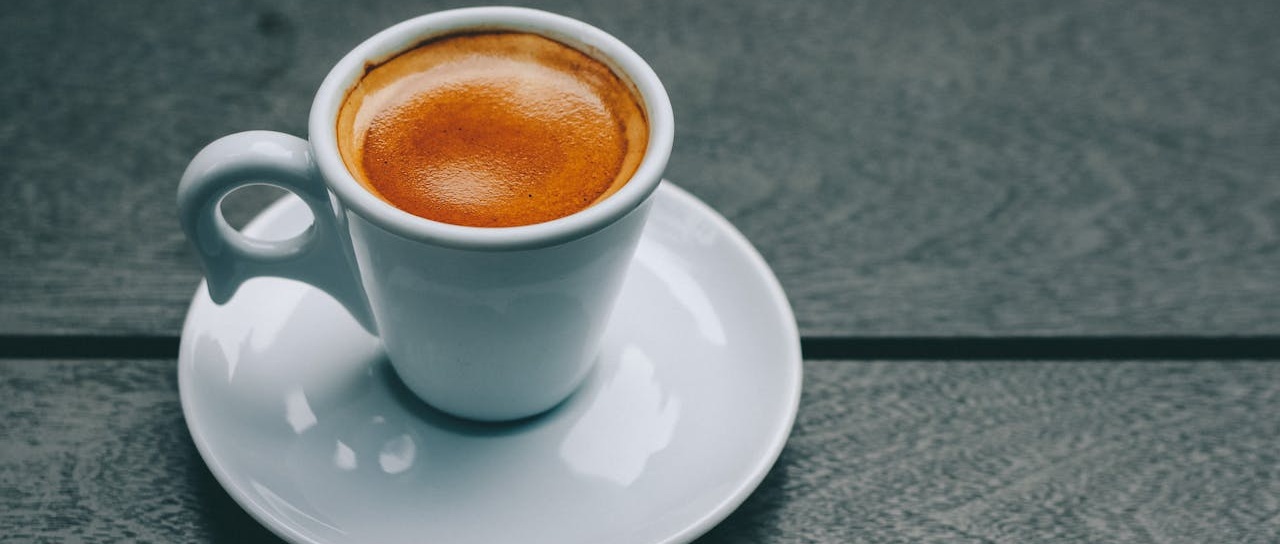
Crema is not a sign of freshness alone — it is the visual record of CO₂ degassing from recently roasted coffee dissolving into the pressurised shot and re-emerging as the pressure drops. Beans roasted within 4–14 days produce the most stable crema. Over time, CO₂ dissipates and crema production falls. The crema layer also contains lipids that carry aroma compounds, which is why espresso smells disproportionately intense relative to its volume.
Espresso and the Ristretto distinction
Ristretto uses the same dose but extracts less liquid — roughly 15–20 ml — at a marginally finer grind. The result is sweeter and more concentrated, with a different flavour profile. Lungo, by contrast, extracts 50–60 ml, diluting body while extending bitter compounds. These three — ristretto, espresso, lungo — form the foundational trio of Italian espresso culture.
Best served as
Espresso is consumed alone in a pre-warmed 60–90 ml ceramic cup. In Italy it is traditionally drunk at the bar within seconds of extraction. At home or in third-wave cafés, it serves as the base for Cappuccino, Flat White, Caffe Americano, Macchiato, and Cortado.
Equipment
A quality result requires a pump-driven espresso machine (semi-automatic or manual lever), a burr grinder capable of fine, consistent adjustment, and a tamper. Notable machine manufacturers include La Marzocco, Slayer, Rocket Espresso, and ECM. For home use, Breville, Jura, and De'Longhi offer accessible entry points.
How to prepare
- Dose and grind. Weigh 18 g of freshly ground coffee (fine, 200–400 microns). Distribute evenly in the portafilter basket.
- Tamp. Apply 15–20 kg of level, even pressure with a calibrated tamper. A crooked tamp creates uneven flow channels.
- Flush the group head. Run 2–3 seconds of hot water through the group before inserting the portafilter to stabilise temperature.
- Extract. Lock in the portafilter and start the shot. Target 36 g of liquid in 27–32 seconds (1:2 brew ratio). Stop manually or use a scale.
- Taste. A balanced shot tastes sweet, slightly acidic, and mildly bitter. Adjust grind finer if sour (underextracted) or coarser if harsh and dry (overextracted).
What to avoid
- Stale beans. Espresso degasses rapidly after roasting. Use beans within 4–14 days of roast date; crema thins significantly after 21 days.
- Pre-ground coffee. Oxidisation begins within minutes of grinding. Always grind immediately before extraction.
- Cold portafilter. A cold metal basket drops water temperature at the puck and produces uneven extraction. Keep the portafilter locked in the group between shots.
- Inconsistent tamping pressure. Angled tamps create water channels through the puck and uneven extraction. Use a leveller or self-levelling tamper.
- Wrong grind for the machine. Espresso grind varies significantly by machine type and barometric pressure. Dial in every new bag of beans.
Tips
- Pre-infuse if your machine supports it. 5–8 seconds of low-pressure pre-infusion before full pressure evens out the puck and reduces channelling.
- Warm your cup. A cold 60 ml cup drops espresso temperature by 5–8 °C on contact. Rinse with hot water first.
- Single-dose and weigh both in and out. The most reliable way to achieve consistent results is a precise dose in and a target weight out on a scale.
- Keep records. Note grind setting, dose, yield, time, and taste. Espresso variables interact — notes let you track the direction of changes.