Guides
Coffee Shop Simulators: Real or Fantasy?
Steam is full of cafés you can run without rent, staff or a single difficult supplier. Where the genre gets coffee culture right, and where it stays a fantasy.
Guides7 min readUpdated October 15, 2026

Guides
Steam is full of cafés you can run without rent, staff or a single difficult supplier. Where the genre gets coffee culture right, and where it stays a fantasy.
Coffee shop simulators let you run a café without paying rent, hiring staff or dealing with a supplier who sends the wrong grind. They are very popular, and the appeal is easy to understand: they offer the atmosphere of a good café without the parts that make running one hard.
The interesting question is not whether they are realistic. It is what they choose to include, what they leave out, and why they still feel like coffee.
Management games have covered everyday businesses for years, from farms and restaurants to hospitals and theme parks, and a café fits the format well. It has a clear daily routine, obvious upgrades from one machine to a better one, and a space the player can rearrange. It also offers something many business games lack: a look and feel that players already enjoy.
Coffee culture supplies that atmosphere. Warm light, wooden counters, steam, the sound of milk being steamed: these are familiar images, and they carry meaning for anyone who has spent time in a good café. The game does not have to explain why the setting matters. It only has to look right.
There is also the appeal of a third place, a room where people can stay without needing a reason. A simulation lets a player build that room exactly as they imagine it and then watch it work.
Play a few café simulators and the same structure appears, sometimes with new art, sometimes refined. Two kinds of game dominate. Management sims focus on optimization, while narrative games use the café as a setting for conversation. A late night visual novel such as Coffee Talk sits at one end of that range, a systems driven builder such as Espresso Tycoon sits at the other, and mobile games such as My Café fall in the middle with a faster, simpler loop.
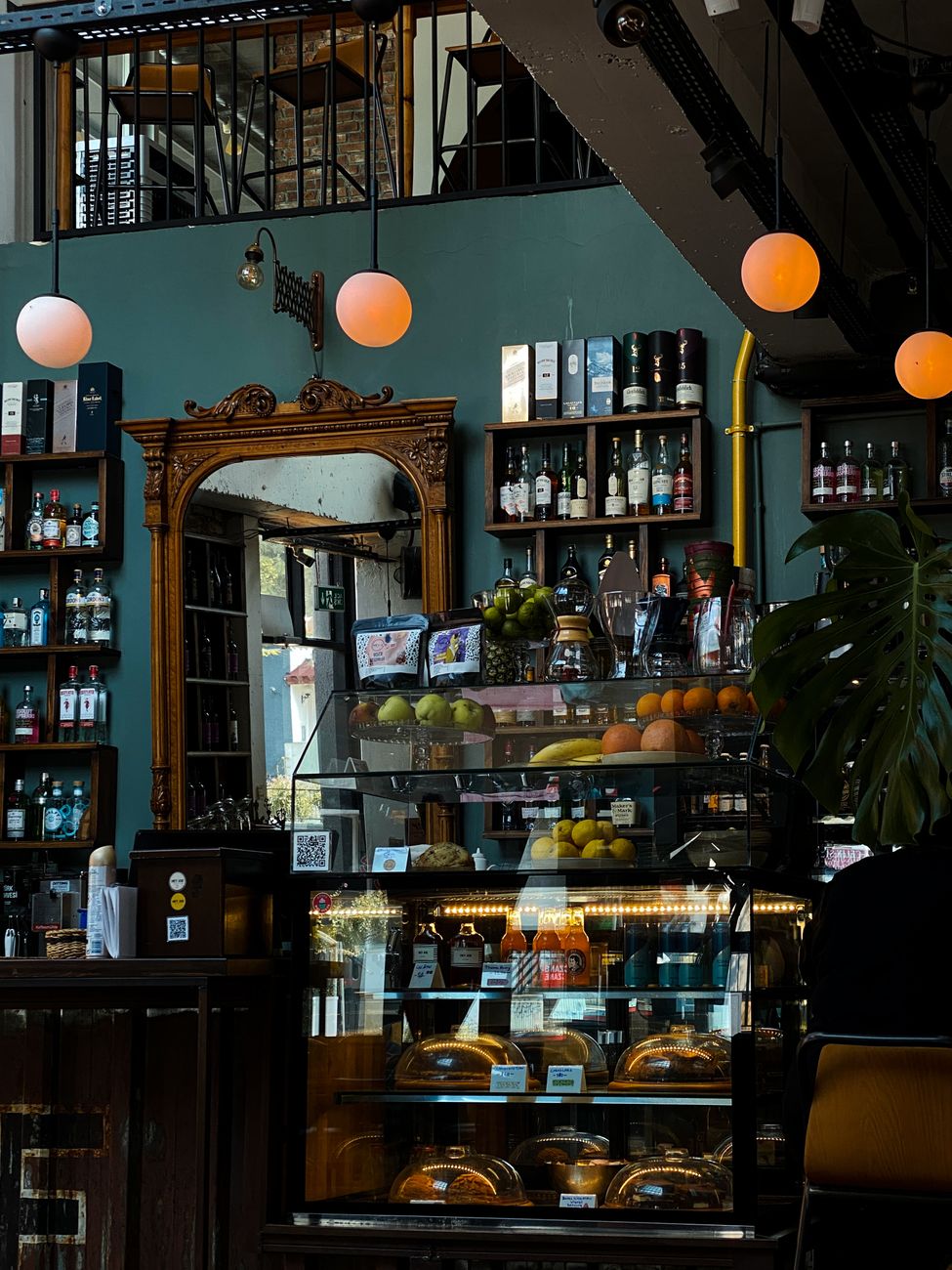
The genre borrows the atmosphere of a good cafe long before it models one.
| Mechanic | How it works in the game | What it stands for |
|---|---|---|
| Equipment tiers | Better machines give a higher quality score and faster service | The real gap between a good machine and a cheap one |
| Staff and roles | Hiring and assigning people to the bar, the floor and the counter | Labor as the real limit on how many drinks you can serve |
| Layout and decoration | Placing furniture, plants and lighting to raise comfort | The physical experience of a room you want to sit in |
| Menu and pricing | Choosing recipes, setting prices and running promotions | Menu design as a business decision, not a craft decision |
| The finance loop | Reinvesting profit into upgrades and expansion | Cash flow, and why good cafés still fail |
That structure is why these games feel familiar within ten minutes. It is also why they feel thin after twenty hours: the loop rewards growth, and growing a café is not really what coffee people find interesting.
These games do three things well.
First, they capture the rhythm of service. A café has a quiet opening, a busy mid morning, a slow patch and a second rush, and the games reproduce that pattern. Players feel the difference between a calm room and one with a growing queue, which is the same pressure a barista works with all day.
Second, they show that equipment sets a limit. In a real café, a grinder that cannot adjust finely holds back every drink it makes. Games express the same idea in a simple way: upgrade the machine and the quality score rises. The numbers are invented, but the principle is real.
Third, they treat the space as important. In a café, the design affects who comes in, how long they stay and what they order. Where a seat goes, how the light falls, whether the counter invites conversation: the games reward this kind of thinking, even if they score it roughly.
A café simulator is a business fantasy, and what it leaves out is exactly what makes specialty coffee difficult.
| Element | In most café sims | In a working specialty café |
|---|---|---|
| The coffee itself | A recipe button, sometimes an upgrade | Origin, variety, process, harvest and roast date all change the cup |
| Extraction | A quality score that equipment raises | Dose, grind, yield, time and temperature adjusted through the day as the beans change |
| Milk texture | An animation that finishes in seconds | Steaming that a trained palate notices right away |
| Maintenance | Almost entirely missing | Backflushing, descaling, new burrs, grinder calibration, waste |
| Supply | Stock refills at the press of a button | Contracts, seasons, price changes and a harvest that may not arrive |
| Economics | Profit builds up and upgrades follow | Thin margins where rent and labor decide whether the coffee matters at all |
Water chemistry never appears. Dialing in never appears. No one ever recalibrates a grinder because the humidity changed overnight. The result is a game where coffee is the theme and the look, but almost never the system.
Some software simulates coffee far more seriously, and it is not sold as a game. Roast logging tools such as Cropster and Artisan track bean temperature and development through a roast and let you compare batches. Extraction calculators work out dose, yield and strength for a target recipe. Refractometers measure what actually ends up in the cup.
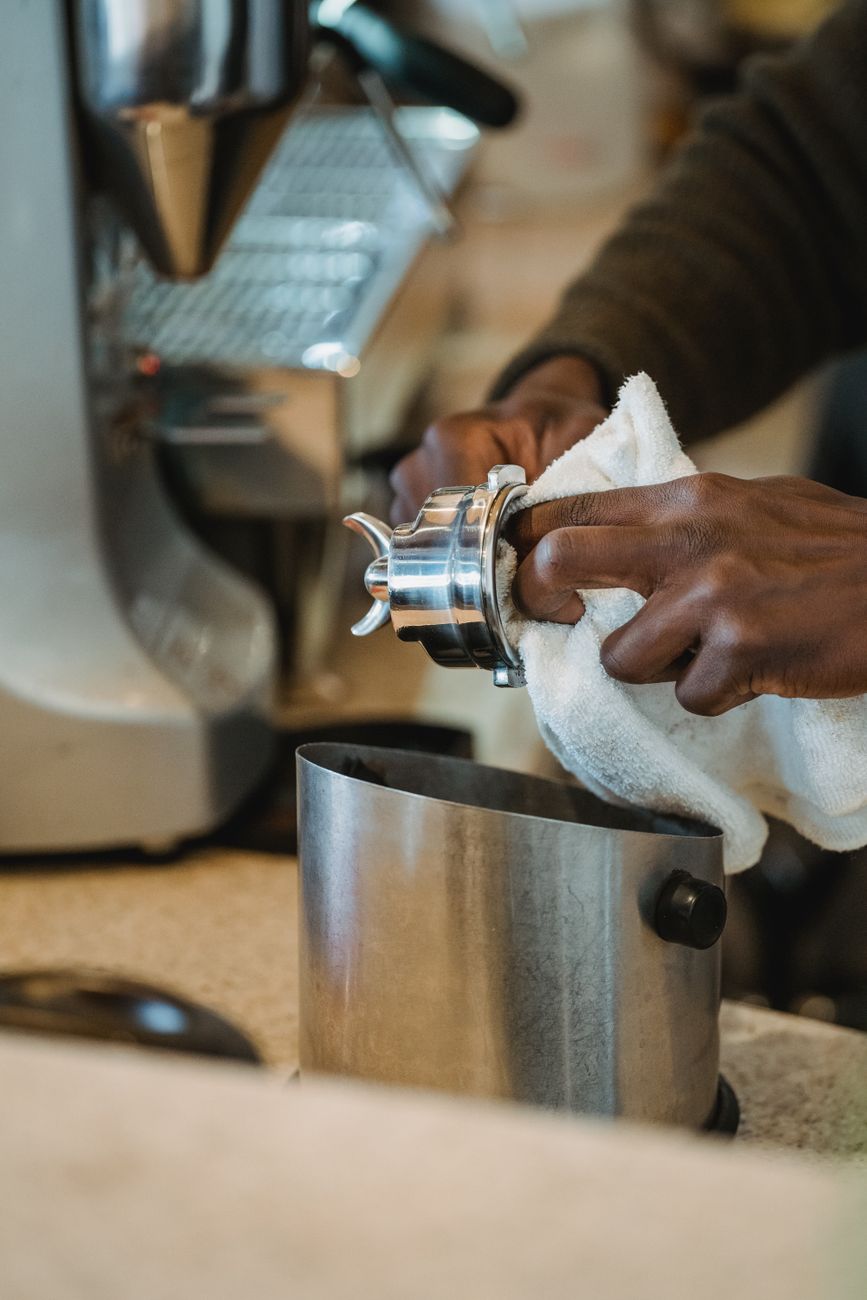
Maintenance is invisible in simulations and constant in a working bar.
Roasters and baristas use these tools because they replace guesswork with numbers, and none of them is designed to be fun. The gap between a café management game and a roast profile is not something more development budget could close. They serve different audiences: one wants a relaxing evening, the other wants the same result again next week.
If you want to learn about coffee, the order does not change: practice on real equipment, read about extraction, and use measuring tools once you know what you are trying to taste. A game can show you what a queue feels like. It cannot show you what a good espresso tastes like.
Where these games work best is outside the game itself. Players share café layouts, discuss the best routes through the game, compare designs and write guides for getting through a difficult start with no money. Discord servers, forums and streaming keep a single player game going for years, and developers support that with updates, seasonal events and new recipes.
Players often set their own challenges, such as building the best café in a small space, recreating a real venue, or working with an awkward layout. It is the same energy the coffee world puts into latte art competitions and brewers cups: people taking a craft seriously enough to compete, with the competition giving them a reason to keep practicing.
Yes, as long as you know what you are getting. These games are a tribute to the look and rhythm of café life, not a training tool, and the best ones are honest about that. If you want a calm, well designed puzzle with good atmosphere, the genre delivers. If you want to learn how to dial in an espresso, you will finish the game knowing exactly what you knew at the start.
There is one related question these games do not answer: what caffeine actually does to a player during a long session. That is a separate subject with its own evidence, and we cover it in our guide to coffee and gaming.
Only in a general way. They can familiarize you with drink names and the idea that equipment limits quality, but they do not model extraction, roasting, water or origin. Treat them as entertainment with a coffee theme rather than a substitute for practice.
They combine clear goals, visible progress and no competitive pressure, which is the pattern behind most cozy management games. Add a setting many players already enjoy, and the result is a low stress loop with something to aim for: running your ideal café without the licensing, the suppliers or the staffing problems.
Not as games. The serious equivalents are professional tools: roast logging software such as Cropster and Artisan, extraction calculators and refractometers. They serve people who need repeatable results rather than an evening of entertainment, which is why the two categories have stayed separate.
It depends on what you want. Management sims such as Espresso Tycoon reward optimization and layout planning, narrative games such as Coffee Talk use the café as a setting for conversation rather than systems, and mobile titles such as My Café compress the loop into short sessions. Pick by mood rather than by accuracy.
Almost none, and the gap is built into the format rather than accidental. Grind adjustment, dialing in, milk texture, cleaning routines and supplier relationships are either missing or reduced to a progress bar, because those are exactly the systems a relaxed management loop is designed to leave out.